Classic Rock!

Classic Rock!

Sunday, October 16, 2011

The Megatron

Well, I've got a new big project to start after Im done with my synth. A digital mellotron.

The mellotron uses tapes with recordings of actual instruments on them to make sound. Some classic sounds are flute, strings, cello, choir, and violins. Each key has a tape loop with three different instruments, so when you press a key, the tape is played and you get about 7 seconds of sound.


 Mellotron tapes


The mellotron is very quirky and has lots of problems, but it just has such a unique dark sound. This instrument can be heard on many classic recordings such as the flute intro to"strawberry fields forever" and the string sounds in pretty much every Moody Blues song. Anyway, I really want one but they very rare and hard to come by (and expensive too!). So I had the idea to use a sampler to play mellotron samples and use a midi keyboard to control it. Others before me have done the same thing, but I like the idea. What I want to do is build a case for it that resembles a real mellotron, but instead uses the digital sampler to play the mellotron samples. It will also include a mixer that I will build to run all my other keyboards through. Then the base will be a big, high wattage tube amplifier that the mellotron and mixer will run through.


The keyboard part can be removed from the base and each part can be used separate from each other. It will also be easier to transport that way. 

Wednesday, June 1, 2011

Custom "Leslie" rotating speaker

A Hammond organ isn't quite complete without a leslie speaker. Leslie speakers are also great for other instruments such as guitars, vocals, etc. Of course an original leslie is way overpriced and hard to find. I thought I would build a matching one to go with my Hammond instead. I received an amplifier out of a leslie 25 speaker from a friend's dad and I decided to build a speaker cab around that. The Leslie speaker uses the the doppler effect to modulate frequency. There is a high and low range speaker. The high range speaker fires into a horn, which rotates and in turn creates a vibrato/tremolo sound. The low range speaker does the same thing, except it fires into a baffle that spins.

Heres the inside of a real Leslie.

I wanted my speaker to be a little smaller and easier to transport, but the design is very similar to an original leslie.


The start of the cabinet. Its made out of the same red oak plywood that the hammond chop is made out of.


A mock of a few of the parts.


heres a crappy cellphone video of the speaker working.

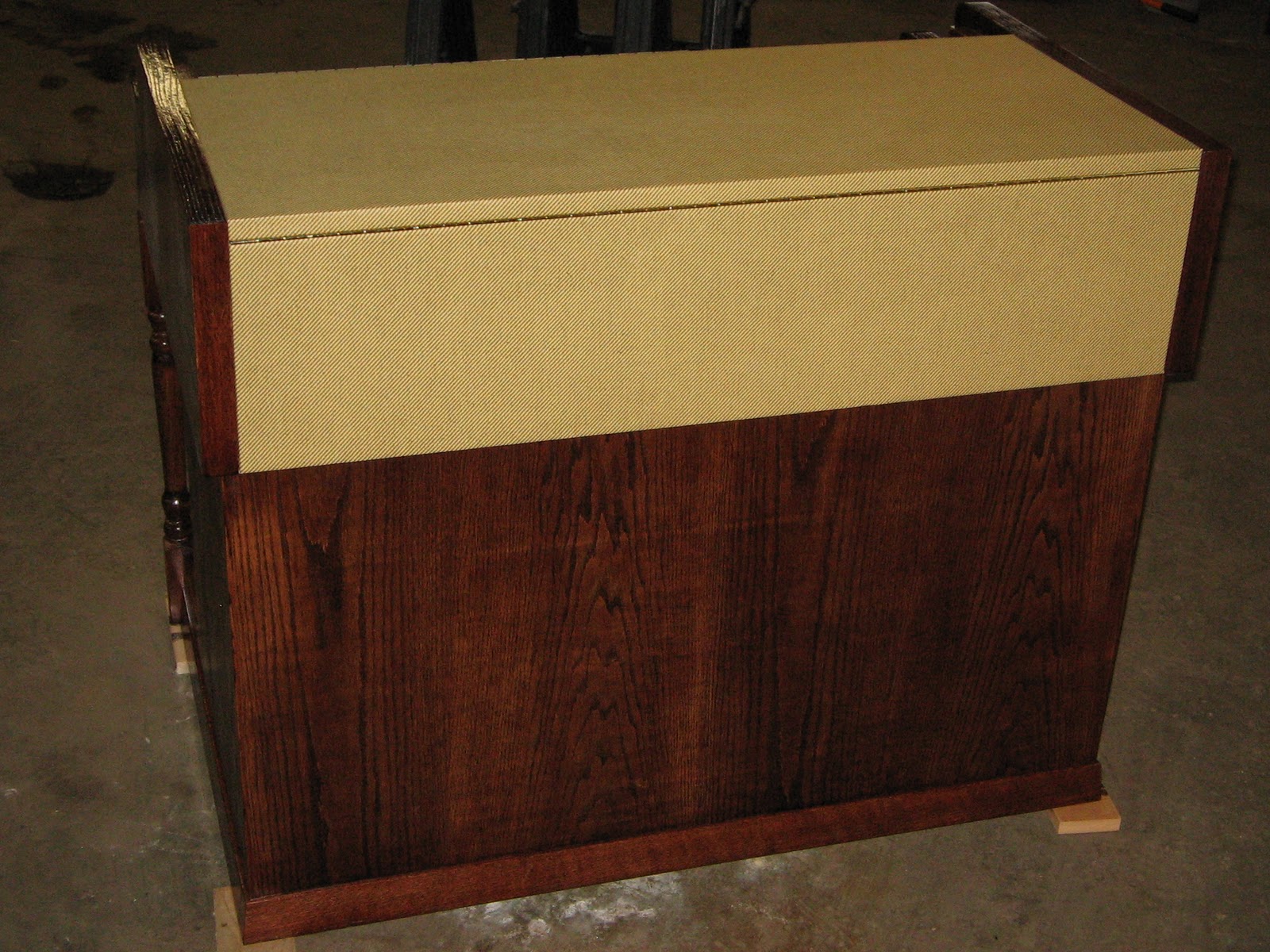
Tweed covering on one of the sides.


I put the cabinet on wheels so its easy to move. It will also have the same handles that are on the Hammond.


The first few coats of stain.


Well, I was working on a bearing system for the horn and I dropped the stupid thing on the ground and it shattered! I was able to glue all the pieces together, and it hasn't exploded yet, so hopefully it will stay that way!


Pretty much complete in this picture. I will get some much better, non-cellphone pictures soon.


Friday, November 5, 2010

Drawings

Not much to post here. Mostly drawings done in photoshop with a wacom bamboo tablet.
not finished

I used to watch Gargoyles "way back in the day", it was probly the one of the coolest kids shows of all time, pretty dark and deep, not really a kids show. Anyway, heres Goliath from the show rockin' some cool headphones.


Probly gonna screen print this on my macbook. "Classic Rock!"

Unfinished picture of a steampunk dude with some massive confangled steam powered music playin' device!

Friday, October 15, 2010

The Rebirth of a Classic

The Hammond organ, the most well known classic keyboard of all time. The hammond was poplar in rock, blues, jazz, prog, gospel, funk, and various other genres of music. The most famous of the hammond organs was the B3, commonly played through a leslie rotating speaker, as seen below.


I got intrigued by the idea of owning a real hammond organ, but at $3000 plus, it seemed a little unrealistic. Of course, there are other great sounding hammond organs such as the M3. The M3 is a spinet model commonly referred to as the "baby B3" because of its use of basically identical parts to the B3, minus the 61 note manuals. The advantage to the M3 is of course the price (generally around $100). I started searching craigslist for an M3 and came across on in nonworking condition for 200 bucks. I decided to go take a look at it and found it to be in pretty decent shape. All the tubes warmed up and the start motor worked, but the tone generator just wouldn't spin. I figured this 54 year old instrument should be pretty easy to fix, so I talked the guy down to 80 bucks and took it home. Heres a picture of what it looked like when I brought it home.


After about 5 minutes of tinkering with it, I found that the drive gear on the starter motor was stuck. I moved it a bit with my finger and It worked! Everything worked perfectly and it sounds great! They just don't make stuff like they used to...


See "Rebirth of a classic part II" to see where the project goes from here.

Rebirth of a Classic part II

Sometime in october 2010

The Hammond organ sounds great and all, but have you ever tried to move one? The M3 is just a spinet, but it still weighs roughly the same as a geo metro. I plan on bringing this thing to gigs so I needed to do something about the weight, or at least the bulkiness. A common remedy to this problem is to "chop" it, basically cutting the case down to a more manageable size. Heres a common example.

I didn't really like the idea of cutting up a classic hammond organ, so I decided to build a new cabinet instead.


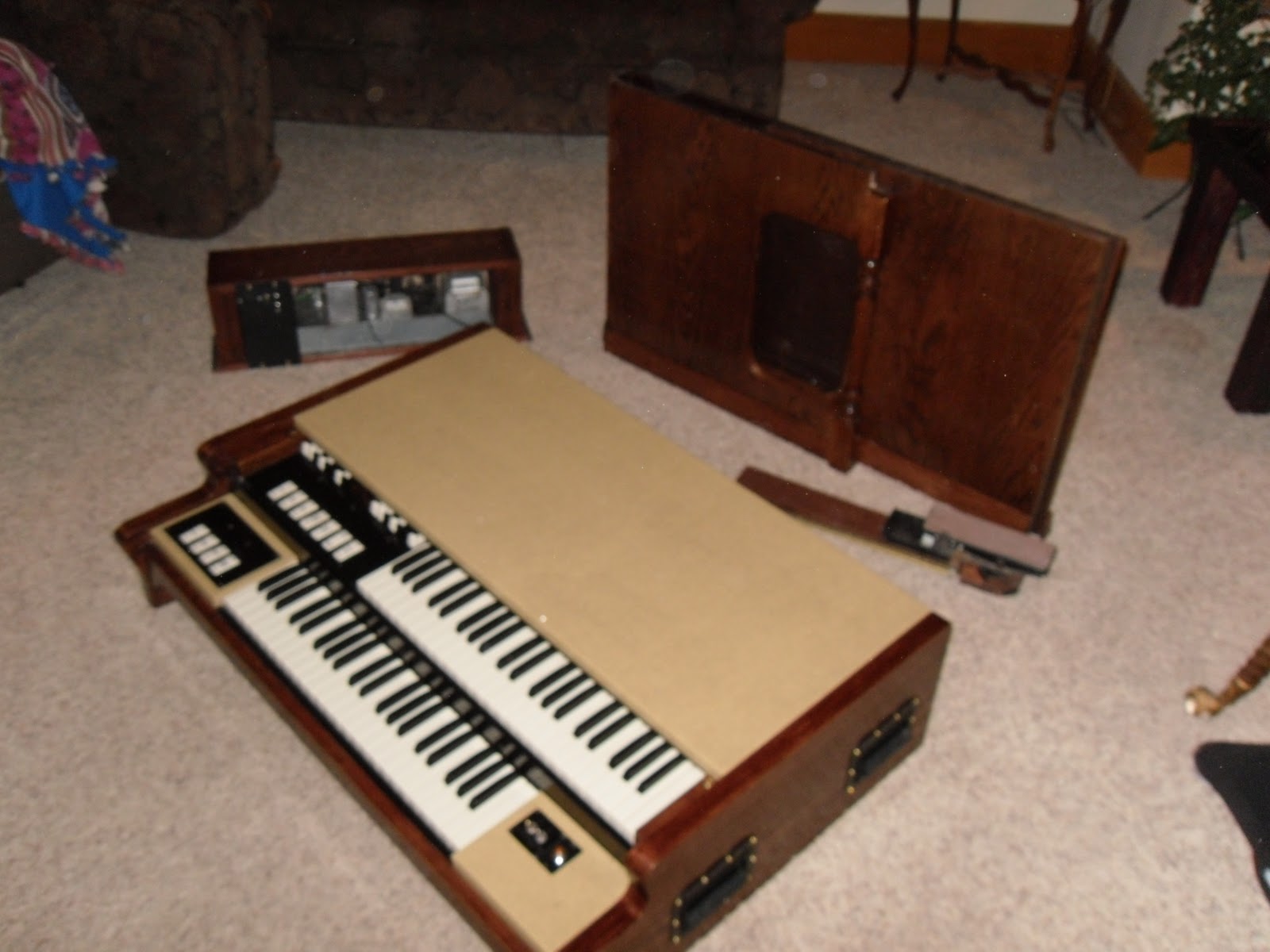
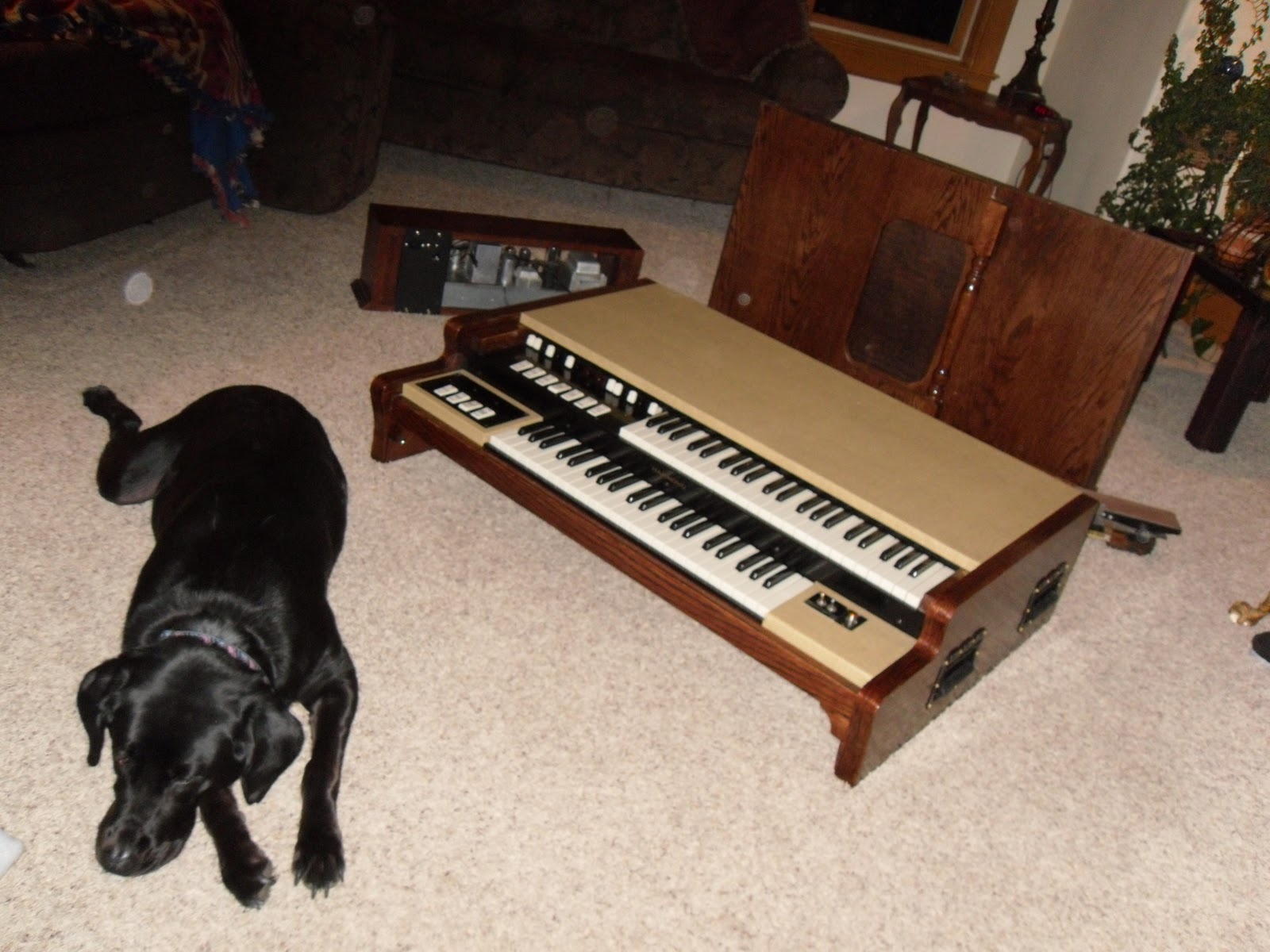
The disassembly


The organs, uh, "organs"


I wanted to includes some similar styling to the B3, while also being a bit more unique. I decided to use red oak, combined with classic tweed cloth for that vintage look. Heres the start of the case.


After some veneer 


And some mahogany stain


Heres the top wrapped in tweed


Some test fitting of the components


Got the cheek blocks covered


Heres a view of the guts


I wanted to still have easy access to the internals, so I decided to make the top hinge open. You can see the piano hinge on the back and a view of the top open.


I built the legs so that they can fold up when you take the Hammond off.


After some stain.


I got some nice heavy duty handles for carrying it.


I built the amp into a removable box that fits on the underside of the organ. The amp connects to the rest of the organ with two 12 pin connectors. I would like to find some nicer metal connectors though.


I used a standard computer type power plug, so if I loose the original a replacement won't be hard to find.


These are all the different pieces when it is all disassembled.